Articles

Keep up to date with all our latest news, articles of interest, and case studies from the veterinary world around Hawke’s Bay.

Facial Eczema Monitor – January Week 3

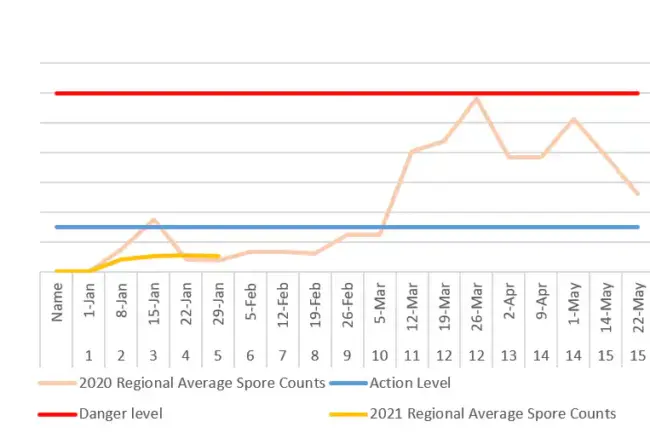
This week’s pasture spore counts – Week ending January 24, 2021 Not unexpectedly with so much long, rank grass beginning to build we are seeing our first FE spores of the year. The warm, humid weather is also a concern. However counts at this stage are thankfully low and so not require any immediate intervention. Nonetheless the…

Details

Facial Eczema Monitor – Hastings Results

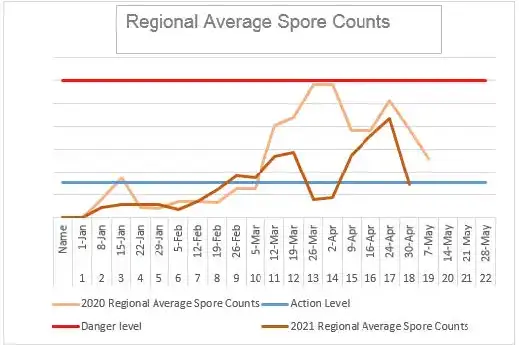
This week’s pasture spore counts – Week ending 7th May 2021 Regional average spore counts have dropped back to low levels, and hotspots have reduced, the highest being 65,000 at Ocean Beach. The dry conditions and cooler overnight temperatures have slowed up spore growth significantly. Known hotspots still pose some risk to grazing stock, especially…

Details

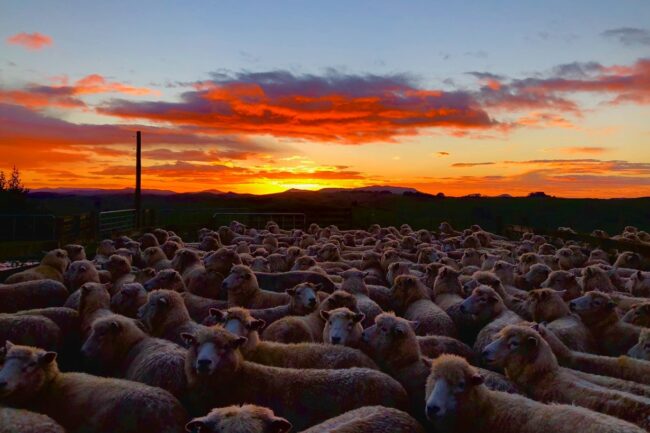
white sheep on brown grass field during sunset

Facial Eczema Monitor – Hastings 30 April 2021

Regional average spore counts have increased again since last week, with counts having risen dramatically over the last 3 weeks. There are individual counts at dangerous levels in several areas (Taihape Road 120,000, Ocean Beach Road 140,000, Eskdale 100,000). Don’t assume your area is safe just because we’ve had cooler nights, get some pasture samples…

Details

Facial Eczema Monitor – February 4th

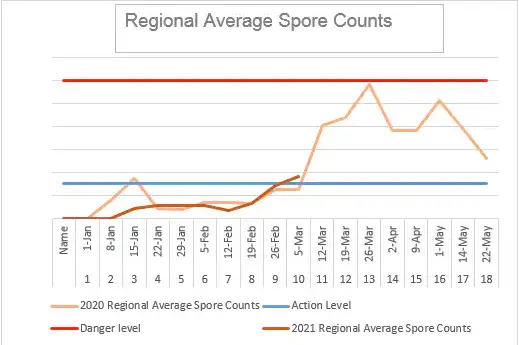
Hastings Results The majority of this week’s spore counts were in the 0,000-5,000 (low) range. The average count across the region was just over 5000, and remains unchanged from the last 3 weeks. One of the sites on Ocean Beach Road remained at 20,000. Spore counts match last year’s trend at this stage. Trend graph…

Details

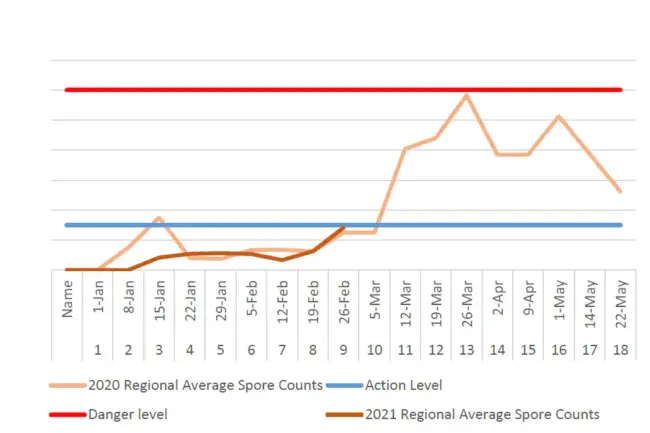
Facial Eczema Monitor – 28 Feb

This week’s pasture spore counts – Week ending 26 February 2021 Hastings Clinic Results  There is a big range in spore counts this week from 0 to 230,000 (highly toxic), whilst some farms remain low the district average counts have double from last week. One of the sites on Ocean Beach Road was 80,000, one…

Details

brown grass field with animals on field during daytime

Facial Eczema Monitor – 26 March 2021

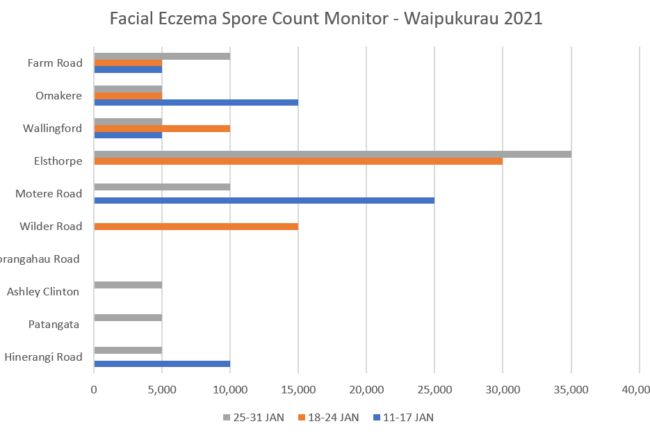
Regional average spore counts are around the 25,000 mark, with hotspots across the region, indicating the risk is not over yet. One of the sites on Ocean Beach Road is still 115,000. Best advice is to monitor the spore counts on your pastures to assess risk more accurately. Hastings Results  Waipukurau Results     Further…

Details

green grass field under white clouds during daytime

Facial Eczema Monitor – 19 March

Waipukurau After a slight increase due to warm rain a few weeks ago the counts have dropped again, and with cooler nights the spore counts are expected to remain in this mid-low zone.  We still have some potential for warm weather for another month or so but it is the night-time temperatures that are needed…

Details

Facial Eczema Monitor – 19 February

Hastings pasture spore counts – Week ending 19 February 2021 The majority of this week’s spore counts were in the 0,000-5,000 (low) range. The average count across the region were 6250, a slight lift on last week. One of the sites on Ocean Beach Road remained at 17,500. Spore counts match last year’s trend at…

Details

FACIAL ECZEMA MONITOR – 12 FEBRUARY

This week’s pasture spore counts – Week ending 12 February 2021 The majority of this Hasting’s spore counts were in the 0,000-5,000 (low) range this week. The average count across the region were 3330, and remains unchanged from the last 3 weeks. One of the sites on Ocean Beach Road remained at 15,000. Spore counts…

Details

Facial Eczema is looking ominous

  Our weekly monitoring of spore counts shows a trend of rising spore counts across the region.   These spore counts are not particularly relevant to your farms actual spore load but highlight the fact that the local farming environment is currently a good environment for growing fungal spores.   Animals can be affected two…

Details

Facial Eczema and Alpacas

Alpacas are very susceptible to the toxic effects of facial eczema spores and high risk periods occur during the summer and autumn. The spores, produced by the fungus Pithomyces chartarum, are broken down in the digestive tract releasing the sporidesmin toxin. The toxin is absorbed into the circulation and reaches the liver where it is…

Details

Facial Eczema – What to Watch For

Written by Isabel Simpson We’ve recently seen a spike in clinical cases of facial eczema across the region. This disease is caused by a fungus that damages the liver, mainly affecting sheep and cattle. Although spore counts dropped last week, we’re not out of the danger period — and we’re now seeing the effects of…

Details